
Today we are announcing the general availability of EasyStack AI Foundation (EAF AI) — our enterprise-grade platform for Agentic AI. EAF AI gives CIOs and platform teams a single, governed place to build, deploy and operate autonomous AI agents on infrastructure they control.
Over the past eighteen months, every enterprise we talk to faces the same tension: AI pilots multiply faster than governance can keep up. Models live in public SaaS, credentials scatter across notebooks, and nobody can answer the simple question — where does our data actually go?
Why agentic AI needs a new foundation
Classic MLOps platforms were designed for models: train, serve, monitor. Agents are different. They hold long-lived state, call tools, spend money through APIs and collaborate with other agents. Treating them as "just another workload" leaves security and cost holes that only appear in production.
EAF AI starts from the agent lifecycle instead of the model lifecycle. Identity, policy, memory and observability are first-class primitives — not bolt-ons.
What is EAF AI
EAF AI unifies four layers that enterprises previously had to assemble by hand:
- AI Infrastructure — GPU pooling, fractional scheduling and high-throughput inference serving on EasyStack ECF.
- Agent Runtime — sandboxed execution with per-agent identity, tool allow-lists and spend limits.
- Orchestration — multi-agent workflows with human-in-the-loop approvals and replayable audit trails.
- Governance Console — one pane of glass for policy, model provenance, data residency and cost.
"Enterprises don't need another chatbot. They need an operating system for agents — with the same rigor we apply to core banking infrastructure."
Architecture overview
EAF AI runs on the EasyStack Cloud Foundation (ECF) substrate and inherits its software-defined compute, storage and networking. Agents execute in micro-VMs with hardware isolation, while the AI gateway terminates every model call — applying policy, caching and token accounting before a single packet leaves the platform.
Because the gateway is the single egress point, adding a new model provider — open-source or commercial — is a configuration change, not a re-architecture.
Governance & security by default
Every agent action is signed, attributed and logged. Policy sets answer the questions auditors ask first:
- Which data classifications may this agent read or write?
- Which external tools and APIs may it call, and with what spend ceiling?
- Which actions require human approval before execution?
- Where must inference run to satisfy data-residency rules?
Combined with ECF's sovereign-cloud deployment modes, this makes EAF AI suitable for regulated industries — government, finance, healthcare and telecom — from day one.
Getting started
EAF AI is available today as part of the EasyStack platform portfolio. Existing ECF customers can enable it through ESCloud Manager with a rolling, zero-downtime upgrade; new customers can start from a three-node reference configuration.
Read the EAF AI whitepaper for the full architecture, or talk to our team to book a technical briefing.
Related posts
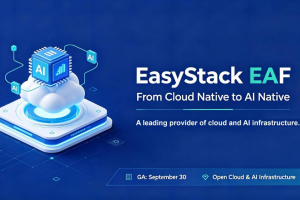
EasyStack Launches EAF, AI-Native Cloud Foundation for Enterprises From Cloud Native to AI Native, Platform Builds an AI-Ready Cloud Foundation
EasyStack officially launched EAF, an AI-native cloud foundation to be generally available on Sep 30, 2026. Built to extend AI capabilities atop existing cloud infrastructure instead of deploying separate AI stacks, EAF unifies heterogeneous AI accelerators, improves GPU utilization and automates cost governance. With flexible deployment options, it completes EasyStack’s end-to-end cloud and AI portfolio. Hardware-agnostic and model-neutral, EAF helps enterprises smoothly evolve from cloud-native to AI-native.
Read more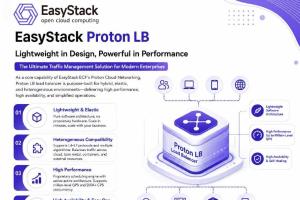
EasyStack Proton LB: Lightweight, High-Performance Software-Defined Load Balancer
EasyStack Proton LB is a software-defined load balancer with lightweight design and strong performance. It provides high performance, high availability and streamlined traffic management for cloud, container, bare metal and on-prem environments, helping users accelerate scaling, boost application reliability and optimize infrastructure.
Read more
AI is transforming the insurance industry and it starts with the right infrastructure.
EasyStack provides insurers with secure, private and scalable AI infrastructure for compliance, efficient resource management and intelligent innovation.
Read more