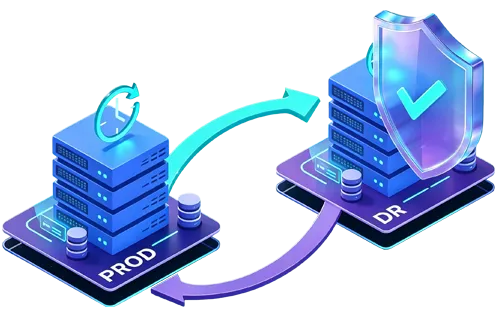
EasyStack Disaster Recovery (DR) Solution delivers automated, orchestrated protection for workloads running on ECF (Cloud Infrastructure Platform), ECNF (Cloud Native Infrastructure), and EAF (AI Infrastructure Platform). Built on the EOS Digital Native Engine and leveraging proven agent-based replication technology, the solution provides continuous data protection, predefined DR plans, one-click failover, and automated failback.
One DR control plane for VMs, containers, bare metal and AI
As enterprises migrate from VMware to open private cloud platforms and deploy AI workloads, disaster recovery requirements grow more complex. Workloads span VMs, Kubernetes containers, bare metal, and AI inference services. Data must remain within national borders. RTO and RPO expectations are tightening. Traditional DR solutions — based on storage replication or manual runbooks — are too slow, too expensive, and too fragile for modern hybrid workloads.
EasyStack DR Solution addresses these challenges. It integrates natively with ECF for VM and volume protection, ECNF for Kubernetes and container workloads, and EAF for AI model repositories and inference services. Using agent-based block-level replication, it continuously protects workloads from production sites to DR sites — whether on-premises, in a second EasyStack region, or in a sovereign cloud environment.
DR plans define the orchestration of recovery: which workloads to recover, in what order, with what network mappings and resource specifications. Failover can be triggered manually or automatically. Failback returns workloads to production with zero data loss or downtime.
With EasyStack DR, enterprises can:
RPO & RTO
Achieve RPO of minutes to zero and RTO of minutes.
Workload coverage
Protect virtual machines, containers, and AI inference services.
Failover orchestration
Automate failover orchestration with predefined DR plans.
DR testing
Test DR strategies without disrupting production.
Sovereignty & compliance
Maintain data sovereignty and compliance across regions.
Why modern disaster recovery is a strategic imperative
Downtime cost, regulation, VMware replacement and AI workloads are converging at the same time.
The cost of downtime
For financial services, government, energy, and healthcare organizations, even minutes of downtime can result in millions of dollars in losses, regulatory penalties, and reputational damage. Industry analysts consistently report that the majority of organizations experience at least one significant IT outage per year, and the average cost per hour of downtime continues to rise.
Regulatory and sovereignty requirements
Regulations such as Indonesia's PDP Law, Thailand's PDPA, and Europe's GDPR require data to be protected and often kept within national borders. Disaster recovery sites must comply with the same sovereignty requirements as production sites. EasyStack DR enables sovereign, on-premises DR across regions within the same jurisdiction.
VMware alternative drives DR modernization
As enterprises replace VMware with open platforms like EasyStack ECF, their existing VMware-centric DR solutions — such as SRM — may no longer be applicable. EasyStack DR provides a vendor-neutral, platform-agnostic alternative that protects KVM, OpenStack, container, and AI workloads from a single control plane.
AI workloads require new DR approaches
AI inference services, model repositories, and Agentic workflows are stateful, latency-sensitive, and often business-critical. Traditional backup-and-restore is insufficient. EasyStack DR supports continuous replication and automated failover for EAF workloads, including model service endpoints and inference configurations.
Challenges
Seven challenges in enterprise disaster recovery
Legacy DR tools were not designed for heterogeneous, sovereign, AI-era workloads.
Challenge
Description
Heterogeneous workloads
VMs, containers, bare metal, and AI services require different protection strategies.
Slow recovery
Manual runbooks and storage-based replication often lead to RTO of hours or days.
High cost
Dedicated DR hardware and standby infrastructure are expensive and underutilized.
Complex testing
DR drills disrupt production and are difficult to schedule and validate.
Sovereignty
DR sites must comply with the same data residency regulations as production.
Orchestration
Recovery order, network mapping, and dependencies must be automated, not manual.
Agent overhead
Traditional agents consume resources and require maintenance on every protected host.
Solution Architecture
Built on the EOS Digital Native Engine, orchestrated by DR plans
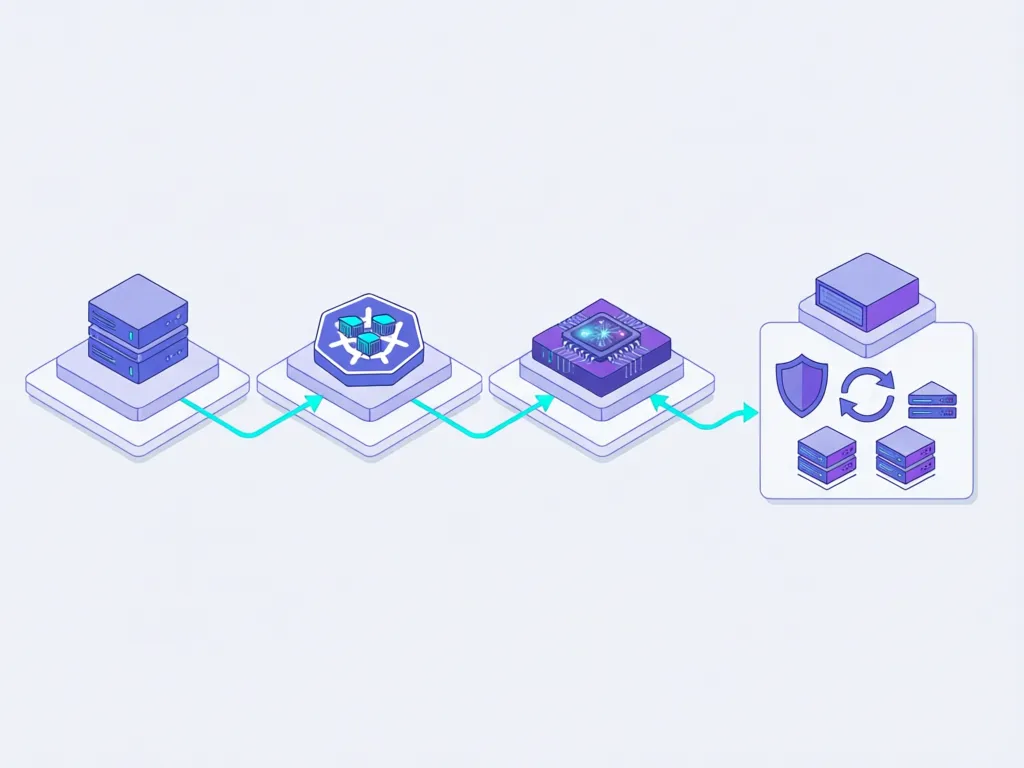
A DR control plane, replication agents, cloud agents, DR site storage and a DR plan repository.
EOS Digital Native Engine foundation
EOS — Digital Native Engine
EasyStack DR is built on the EOS Digital Native Engine, the same microservices-based, fully symmetric distributed cloud operating system that powers ECF, ECNF, and EAF. EOS provides:
Unified lifecycle management for over 150 microservices
OTA smooth upgrades with zero business impact
High availability and fault self-healing
Open APIs for integration
DR architecture components
DR Controller
Central control plane for replication management, DR plan orchestration, and failover/failback. Provides web UI and RESTful API.
Replication Agent
Installed on protected hosts (or provided as an appliance). Performs block-level changed block tracking (CBT) and sends incremental changes to the DR site.
Cloud Agent
Auxiliary VM on the target DR site that receives replicated data and writes it to target storage.
DR Site Storage
Target storage for replicated data: local disks, EasyStack volume disks, NFS, or S3-compatible object storage.
DR Plan Repository
Stores predefined DR plans containing machine specifications, network mappings, boot order, and orchestration instructions.
Replication architecture & DR plan orchestration
Agent-based block-level replication
EasyStack DR uses agent-based block-level replication:
Initial replication: Full synchronization of protected workloads to the DR site.
Replication intervals: Configurable from seconds to hours, enabling RPO from near-zero to minutes.
Bandwidth control: QoS settings prevent replication traffic from impacting production performance.
Deduplication and compression: Reduce storage and network consumption at the DR site.
DR plan orchestration
DR plans are the heart of recovery automation. Each plan defines:
Machine specifications: vCPU, RAM, disk, and flavor for failover VMs.
Network mappings: Source-to-target network and security group mappings.
Boot order and dependencies: The sequence in which workloads are recovered.
Pre/post scripts: Custom actions before or after failover.
Recovery point selection: The point-in-time snapshot to use for recovery.
Plans can be created in Basic mode (graphical interface) or Expert mode (JSON-based for complex scenarios). Plans can be generated automatically from protected machines or from a CSV file for large-scale environments.
Core Capabilities
From continuous protection to automated failback
Continuous data protection, predefined DR plans, one-click failover, non-disruptive testing, multi-tenant DR and compliance.
Capability
What EasyStack DR delivers
Continuous Data Protection
EasyStack DR continuously replicates protected workloads from the production site to the DR site. Replication is agent-based and operates at the block level, making it hypervisor-agnostic and workload-agnostic. Supported source workloads include:
ECF: KVM-based VMs, volumes, and hyperconverged clusters
ECNF: Kubernetes persistent volumes, container images, and application state
EAF: Model repositories, inference configurations, AI Workspaces, and API gateway settings
Bare metal: Physical servers via agent-based replication
Predefined DR Plans
DR plans eliminate manual runbooks. Administrators define recovery scenarios in advance — specifying which workloads to recover, in what order, and with what network and resource mappings. When disaster strikes, recovery is a single click.
One-Click Failover
Failover can be triggered manually or automatically based on health checks. The DR Controller orchestrates:
Provisioning target VMs on the DR site according to the DR plan
Attaching replicated data volumes
Applying network and security mappings
Starting workloads in the correct order
Validating recovery success
RTO is measured in minutes, not hours.
Non-Disruptive DR Testing
EasyStack DR supports non-disruptive DR testing. Administrators can run failover scenarios in an isolated environment without affecting production. Test results validate the DR plan, network mappings, and recovery time, ensuring readiness before a real disaster.
Automated Failback
After the production site is restored, failback returns workloads to production with zero data loss or downtime. Failback supports:
Incremental synchronization of changes made during failover
Automated VM creation on the source site
Validation before cutover
Minimal business impact
Multi-Tenant DR
For cloud service providers and large enterprises, EasyStack DR supports multi-tenant DR with:
Tenant-isolated replication and recovery
Role-based access control (RBAC)
Per-tenant DR plans and storage quotas
Audit logs retained for ≥180 days
Security and Compliance
Data never leaves the sovereign domain (both production and DR sites within jurisdiction)
Encrypted data transmission (TLS)
One-way hashed API keys
Audit logs for all DR operations
Compliance with Indonesia PDP Law, Thailand PDPA, GDPR, and financial regulatory requirements
RPO and RTO targets
Configuration
RPO
RTO
Continuous replication (seconds interval)
Near-zero to seconds
Minutes
Scheduled replication (15 min – 3 hours)
15 minutes – 3 hours
Minutes
Synchronous replication (for critical workloads)
Zero
Minutes
DR for ECF / ECNF / EAF
One control plane, every workload type
Region-to-region, hybrid, VMware-to-ECF, Kubernetes and AI inference DR — plus a unified view across all three platforms.
ECF Disaster Recovery
Protected workloads: KVM-based VMs, volumes, hyperconverged clusters, and software-defined storage.
DR scenarios
Region-to-region DR: Production in Region A, DR site in Region B (both EasyStack ECF).
Hybrid DR: Production on-premises ECF, DR site in a sovereign cloud or secondary data center.
VMware-to-ECF DR: Protect VMware VMs and fail over to ECF in case of disaster or migration.
Key capabilities
Continuous block-level replication of VM disks
DR plans with VM flavor, network, and security group mappings
Kubernetes cluster DR: Protect ECNF clusters and fail over to a DR ECNF cluster.
Application-level DR: Protect persistent volumes and application state for stateful workloads.
Cross-cluster recovery: Recover applications to a different ECNF cluster with different node specifications.
Key capabilities
Persistent volume replication
Kubernetes API integration for workload recovery
DR plans with namespace and service mappings
Automated failback with incremental synchronization
EAF Disaster Recovery
Protected workloads: Model repositories, inference configurations, AI Workspaces, API gateway settings, and token metering data.
DR scenarios
AI inference DR: Protect inference services and fail over to a DR EAF cluster.
Model repository DR: Replicate model files and version metadata to the DR site.
Agentic workflow DR: Protect multi-Agent collaboration configurations and sandbox environments.
Key capabilities
Model repository replication with version consistency
Inference endpoint failover with network remapping
API key and quota configuration recovery
Token metering data replication for billing continuity
Unified DR Across ECF / ECNF / EAF
EasyStack DR provides a single control plane for all workload types. Administrators can:
Create DR plans that span VMs, containers, and AI services
Define cross-workload dependencies and boot order
Monitor replication status from one dashboard
Trigger coordinated failover for the entire application stack
Deployment Scenarios
Seven ways enterprises deploy EasyStack DR
From region-to-region and sovereign cloud to DRaaS, government, financial, edge and remote sites.
Scenario
Description
Region-to-region DR
Production in Region A, DR site in Region B (both EasyStack).
On-premises to sovereign cloud
Production on-premises, DR site in a sovereign cloud environment.
VMware Alternative DR
Protect VMware VMs and fail over to ECF.
AI infrastructure DR
Protect EAF model repositories and inference services.
Cloud hosting provider DRaaS
Offer multi-tenant DR as a service to customers.
Government and financial DR
Sovereign DR with audit compliance and data residency.
Edge and remote site DR
Protect remote workloads with centralized DR orchestration.
Business Value & ROI
Measurable value across recovery, cost and compliance
Metric
Value
RTO
Minutes (vs. hours or days with traditional DR)
RPO
Near-zero to seconds (vs. hours with tape or daily backup)
DR infrastructure cost
Significantly reduced by reusing EasyStack infrastructure; no dedicated DR hardware
DR testing frequency
Unlimited, non-disruptive testing vs. annual manual drills
Operational efficiency
Automated orchestration reduces manual recovery effort by >80%
Compliance readiness
Audit logs, data residency, multi-tenancy
Business continuity
99.99% availability across production and DR sites
Cost Savings
EasyStack DR eliminates the need for dedicated DR hardware and standby infrastructure. The DR site can run on the same EasyStack platform as production, with resources provisioned on demand during failover. This reduces capital expenditure and operational overhead.
Risk Mitigation
Automated failover and predefined DR plans reduce the risk of human error during a crisis. Non-disruptive testing ensures DR plans are validated and ready. Compliance with sovereignty requirements avoids regulatory penalties.
Agility
Self-service DR testing and orchestrated failover enable IT teams to respond quickly to business continuity requirements. Multi-tenant DR enables cloud providers to offer DR as a value-added service.
Conclusion
Disaster recovery is not optional
Disaster recovery is not optional—it is a strategic requirement for private cloud, sovereign cloud, and AI infrastructure. EasyStack DR Solution provides automated, orchestrated protection for ECF, ECNF, and EAF workloads from a single control plane.
In an era where business continuity is non-negotiable, EasyStack DR is the reliable foundation for enterprise disaster recovery.
For enterprises replacing VMware, building sovereign clouds, or deploying AI workloads, EasyStack DR delivers:
Continuous block-level replication with RPO from near-zero to minutes
Predefined DR plans with automated orchestration and one-click failover
Non-disruptive DR testing and automated failback
Multi-tenant DR with audit and compliance
Sovereign data protection across regions
Integration with ECF, ECNF, and EAF
Ready to automate your disaster recovery?
Talk to our solution architects about region-to-region and sovereign DR, VMware-to-ECF protection paths and AI workload recovery — built on the EOS Digital Native Engine.