VMware Alternative

Exit VMware. Keep Every Workload Running.

Broadcom's licensing changes have pushed renewal costs up 200% – 1,200%. EasyStack ECF replaces vSphere, vSAN and NSX with an open, HCI-first private cloud — block-level VM migration, DRS-style scheduling, 3-node start, and predictable per-node pricing. No proprietary lock-in.

Illustration of a shattered proprietary cube with a padlock migrating through a glowing arrow of light particles into an open cloud platform with orbiting GPU, NPU and DCU nodes
Summary

A production-grade VMware replacement — open, HCI-first, AI-ready

Since Broadcom's acquisition of VMware, enterprises face bundle-only subscriptions, per-core price hikes of 200%–1,200%, and the loss of perpetual licenses. Renewal season has become a strategic decision point: keep paying, or migrate to an open alternative.

EasyStack ECF (Cloud Infrastructure Platform) replaces vSphere, vSAN, NSX and vCenter with a single software-defined stack built on the EOS Digital Native Engine. Block-level VM migration keeps workloads running during cutover; unified pooling and DRS-style multi-dimensional scheduling preserve the operations model your team already knows.

Start from 3 nodes, grow to thousands — with the same operational model, the same VMs, and an open API path to Kubernetes, bare metal and AI infrastructure.

Predictable TCO

Per-node subscription, no per-core escalation, no forced bundles — typically 40%–70% lower 3-year TCO than a VMware VCF renewal.

Drop-in operations

Familiar VM, cluster, datastore and network concepts; DRS-style scheduling, HA, live migration and snapshot semantics preserved.

Open, no lock-in

OpenStack-compatible APIs, S3 object storage, KVM hypervisor, mainstream CPUs (Intel · AMD · Kunpeng · Phytium · Hygon · Zhaoxin).

AI-ready next step

Same platform extends to EAF for GPU · NPU · DCU pooling, Model-as-a-Service and secure inference — no rip-and-replace later.

Why Exit VMware

Four forces making VMware replacement a board-level decision

Licensing economics, contractual risk, technical modernization and AI-readiness are converging at renewal time.

Licensing shock after the Broadcom acquisition

Perpetual licenses were retired in favor of bundle-only subscriptions. Many customers report renewal quotes 3× to 12× higher than the previous term, with mandatory adoption of VCF even when only vSphere is needed.

200% – 1,200%Renewal price increases reported by enterprise customers
16 CPUMinimum core-per-socket floor for VVF / VCF subscriptions
The market has already voted

Gartner reports 74% of IT leaders are actively evaluating VMware alternatives, and 35% of running VMware workloads are expected to migrate to alternative platforms by 2028.

74%of IT leaders actively exploring VMware alternatives (Gartner)
35%of VMware workloads will migrate to alternative platforms by 2028

Contract & compliance risk

Shorter contract terms, aggressive true-up audits and the end of perpetual entitlements create budget volatility and audit exposure. Sovereignty regulations in the EU, Indonesia and Thailand further constrain where VMware workloads may run.

1 – 3 yrContract terms replace previous perpetual + SnS model
> 75%of EMEA enterprises will "geopatriate" virtual workloads by 2030 (Gartner)

AI workloads don't fit the old stack

VMware's AI story is early and priced as a premium add-on. Enterprises deploying GPU · NPU · DCU inference need pooled accelerators, RDMA networking, KV-cache offloading and Model-as-a-Service — capabilities delivered natively by EasyStack EAF on the same platform.

1 stackVMs, containers, bare metal and AI inference on one platform
3 nodesMinimum footprint to start HCI — same as a vSAN ReadyNode

Where the pain lands

The four line items that dominate a VMware renewal quote.

vSpherePer-core floor16-core minimum per socket, bundled-only SKUs, no standalone ESXi
vSANStorage taxPriced per TiB raw, escalated tiers for ESA / compression / dedup
NSXNetwork add-onForced into VCF bundle even when basic VLAN / VXLAN is enough
SRM · AriaOps premiumDR, capacity and observability now sold as separate subscriptions
Challenges

Five blockers that stop a clean VMware exit

Migration is not just a licensing decision — it is a technical, operational and organizational one.

Workload continuity

Business-critical VMs cannot tolerate downtime during cutover; incremental, reversible migration is mandatory.

Hardware & driver lock-in

Existing servers, HBAs, NICs and storage arrays must be reusable — not replaced with a new certified list.

Operations muscle memory

Admins trained on vCenter expect clusters, datastores, DRS, HA, vMotion and snapshots to behave the same way.

Third-party ecosystem

Backup, monitoring, DB clustering and security tooling must integrate with the new platform from day one.

Compliance & audit trail

Regulated industries require evidence that migration preserves encryption, isolation, IAM and log retention.

Solution Architecture

A one-to-one replacement for the VMware stack

Every layer of vSphere / vSAN / NSX / vCenter maps to an equivalent — and open — EasyStack ECF component.

Compute — replaces vSphere / ESXi

KVM-based hypervisor with unified pooling and DRS-style multi-dimensional scheduling.

  • Live migration, HA, anti-affinity, snapshot, template — semantics match vSphere
  • DRS-style multi-dimensional scheduling across CPU, memory, IOPS and network
  • Cross-ISA support: Intel Xeon, AMD EPYC, Kunpeng, Phytium, Hygon, Zhaoxin
  • GPU passthrough, vGPU and MIG on the same cluster as general-purpose VMs
KVMLive migrationDRS-styleCross-ISA

Storage — replaces vSAN

Distributed block, file and object storage from the same 3-node HCI cluster.

  • Ceph-based distributed block storage with 2-copy / 3-copy / EC policies
  • NFS / CIFS file services and S3-compatible object storage — no extra license
  • Thin provisioning, compression, deduplication, snapshot, async replication included
  • Unified storage-pool monitoring with per-VM IOPS / latency / QoS controls
HCI 3-nodeBlock · File · ObjectS3 APIQoS

Network — replaces NSX

Software-defined VPC, load balancing, security groups and bare-metal networking.

  • VXLAN overlay, VLAN, flat and provider networks — no NSX-T manager required
  • Distributed SDN with security groups, floating IPs, LBaaS and VPN-as-a-Service
  • Bare-metal and Kubernetes workload networking on the same fabric (with ECNF)
  • RDMA / RoCE support for AI training and high-throughput storage networks
VXLANLBaaSSecurity groupsRDMA

Operations — replaces vCenter + Aria + SRM

Single console, OTA upgrades, DR and observability — all included, not sold separately.

  • 4-hour greenfield deployment; 100+ automated inspection items; fault self-healing
  • OTA smooth upgrades — zero business impact, zero data migration, zero service interruption
  • Async DR, active-active DR and cross-site replication built in (SRM-equivalent)
  • ≥ 99.9% availability in HCI HA mode; ≥ 99.99% in full cloud deployment mode
Single consoleOTA upgradeDR built-in99.99% HA
Feature Matrix

VMware vs. EasyStack — side by side

Where the platforms match, where EasyStack extends beyond VMware, and where licensing changes the picture.

Capability

VMware VCF / VVF

EasyStack ECF

Hypervisor & VM lifecycle

ESXi, proprietary, per-core subscription with 16-core minimum

KVM-based, no per-core floor, VM / template / snapshot parity with vSphere

Distributed storage (HCI)

vSAN priced per TiB raw; ESA / dedup / compression gated by tier

Ceph-based block, file and S3 object in one; dedup, compression, EC included

Software-defined network

NSX-T bundled into VCF; separate SKUs for LB, firewall, federation

VXLAN / VLAN, security groups, LBaaS, VPNaaS built in — no add-on SKU

Resource scheduling

DRS with CPU / memory affinity rules

DRS-style multi-dimensional scheduling across CPU, memory, IOPS and network

Upgrades

Major-version upgrades require planning windows and compatibility matrix checks

OTA smooth upgrades — zero business impact, zero data migration, zero downtime

Disaster recovery

SRM sold as separate subscription, plus per-VM licensing

Async DR, active-active DR and cross-site replication included in the base

AI infrastructure

Private AI Foundation sold separately; early-stage; premium pricing

EAF on the same platform: GPU · NPU · DCU pooling, Model-as-a-Service, KV-cache offload, Kata sandbox

Time to first workload

Days to weeks (VCF bring-up, SDDC Manager, workload domains)

4-hour greenfield deployment; 3-node HCI start; grow linearly

Licensing model

Per-core subscription, 16-core minimum, bundle-only SKUs, no perpetual option

Per-node subscription, no bundle requirement, optional services — predictable multi-year TCO

Migration Path

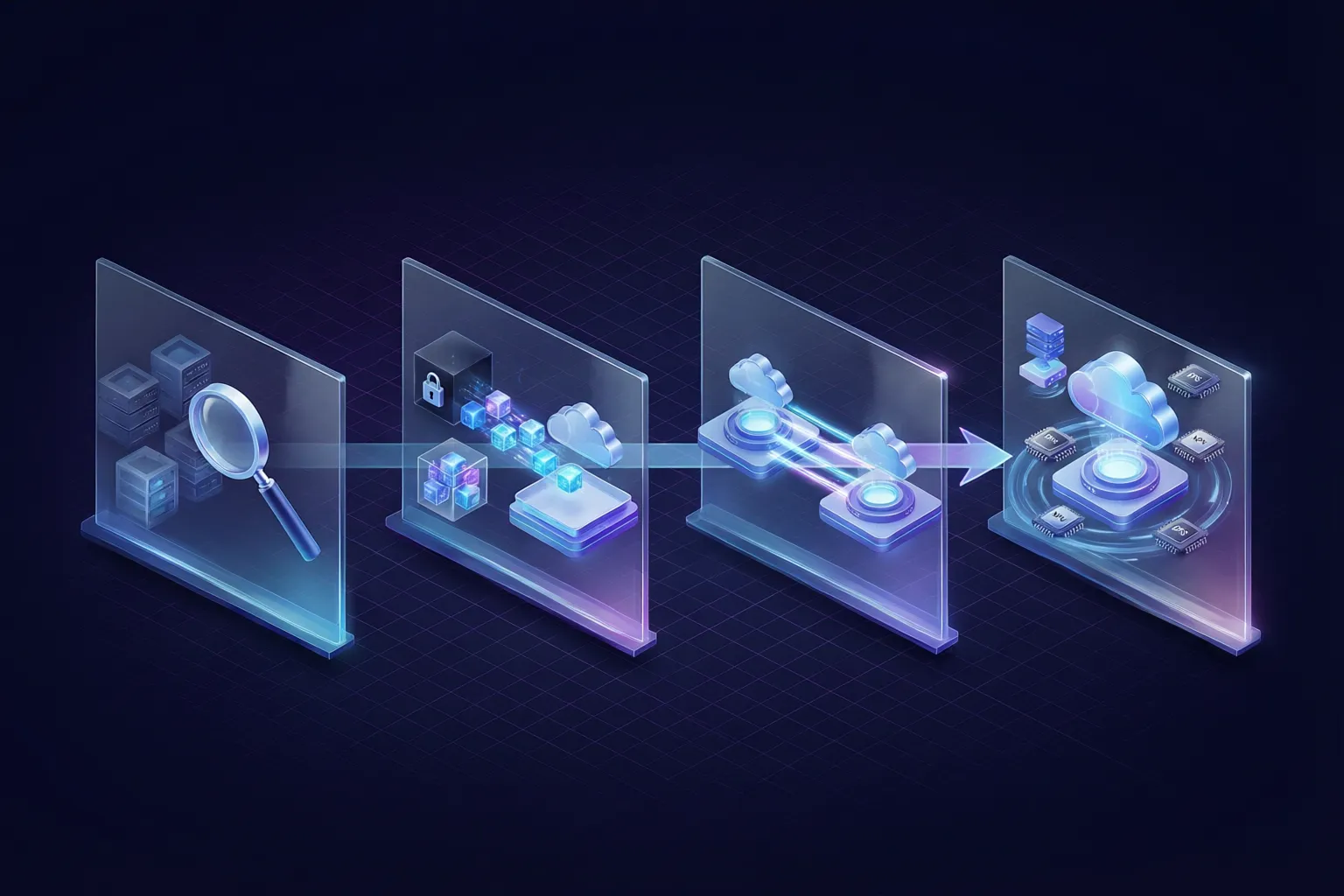
Four stages, one reversible cutover

Every stage is designed so that the previous environment stays intact until the next one is verified in production.

1

Assess & plan

Inventory vSphere clusters, storage policies, network topology and dependencies. Produce a per-VM migration plan with risk tiering and target sizing.

1 – 2 weeksNo production impact
2

Deploy ECF landing zone

Stand up a 3-node (or larger) ECF HCI cluster on the same or new hardware. Configure networks, storage pools, IAM, DR targets and monitoring.

4-hour deploymentReuse existing servers
3

Block-level migration

Migrate VMs incrementally using block-level migration tools — VMDK-to-ECF conversion, image import, agentless replication. Run source and target in parallel until validated.

IncrementalReversibleParallel run
4

Cutover & optimize

Cut DNS / IP / backup targets, decommission VMware hosts, enable DRS-style scheduling, DR policies and OTA upgrades. Extend into ECNF or EAF when ready.

Zero-downtime windowExtend to K8s / AI
Illustration of a four-stage migration journey from a locked proprietary cube through assessment, block-level migration and parallel run to a single open cloud platform
Customer Scenarios

Five workloads that moved off VMware

Representative deployment patterns across regulated and enterprise environments.

Core Business VMs

ERP, databases, line-of-business applications and Windows / Linux workloads that currently sit on vSphere + vSAN. Migrated with block-level tooling during scheduled maintenance windows, running in parallel until validated.

  • VM semantics preserved: snapshot, template, affinity, live migration
  • Backup / monitoring / DB-cluster tooling integrates via OpenStack APIs
  • ≥ 99.99% availability in full cloud deployment mode
ERPDatabasesWindows · LinuxZero-downtime cutover

ROBO / Branch HCI

Retail stores, factory floors, regional offices and telecom edge sites that today run vSAN ReadyNodes with 3–6 hosts. Consolidate onto a single 3-node ECF HCI cluster with centralized, remote full-lifecycle management.

  • 3-node minimum footprint — same as a vSAN ReadyNode
  • Zero-touch provisioning, OTA upgrade and remote fault self-healing
  • One console for hundreds of sites; per-site IAM and quota
RetailManufacturingTelecom edgeBranch offices

Disaster Recovery

Replace SRM + per-VM licensing with built-in async DR, active-active DR and cross-site replication. Keep VMware as the production site and use ECF as the DR target during phased migration — or run both directions.

  • Async replication with configurable RPO down to seconds
  • One-click failover / failback with orchestration runbooks
  • Active-active across two sites with automatic workload rebalance
SRM replacementActive-activeCross-site replication

Dev / Test & Cloud-Native

Give engineering teams self-service VMs, Kubernetes and bare metal on the same platform. Extend ECF with ECNF for container-native workloads, CI/CD runners and internal developer platforms — no separate VMware Tanzu license.

  • OpenStack-compatible APIs; Terraform provider for infrastructure-as-code
  • Project-scoped IAM, quota and billing for internal chargeback
  • ECNF integration for Kubernetes, service mesh and bare-metal provisioning
Self-serviceTerraformKubernetesBare metal

AI Extension

After the VMware exit, extend the same platform into AI infrastructure. Add EAF to pool NVIDIA GPU, Ascend NPU and Hygon DCU, deploy DeepSeek / Qwen / LLaMA / GLM in one click, and expose Model-as-a-Service to internal teams.

  • Unified GPU · NPU · DCU pooling across heterogeneous accelerators
  • KV-cache offloading, single-node multi-card and multi-node distributed inference
  • Secure Kata sandbox, WAF and audit logs retained ≥ 180 days
GPU poolingModel-as-a-ServicePrivate inference

Ready to plan your VMware exit?

Talk to our solution architects about a workload-by-workload migration plan, TCO comparison against your next VMware renewal, or a 3-node ECF pilot in your own data center.